
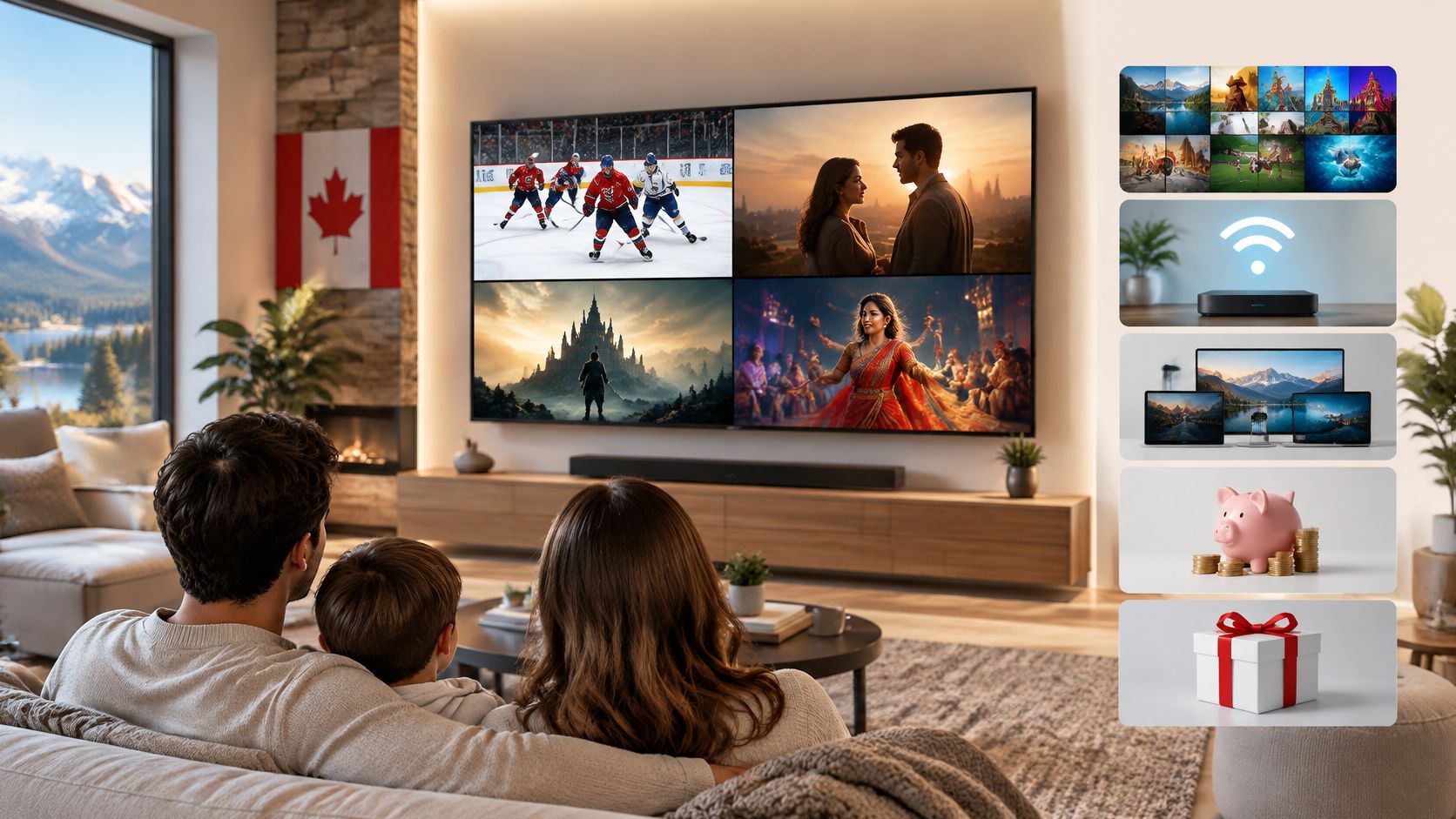
What should you compare before choosing an IPTV provider in Canada? Not the channel count on a sales page. The things you can test yourself are channel range, playback stability on your own connection, device support, subscription flexibility, and whether you can try the service before you pay. Price matters, but a cheap plan that stutters through a Saturday night hockey game is the most expensive subscription you'll own.
Search for the best IPTV provider in Canada and you'll get a wall of channel counts and 4K badges. The adoption numbers say the format itself is settled. The CRTC's 2025 communications monitoring report found that 78% of Canadians subscribed to or had access to at least one video-streaming service in 2025.
This comparison skips brand-name rankings. It looks at five real subscription structures instead, a month, three months and a year, with one or two simultaneous connections, all priced in Canadian dollars, so you can match term length and device count to how your household watches.
Table of Contents
- 1. 12 Months IPTV Subscription Canada
- 2. 12 Months IPTV Subscription Canada – 2 Devices
- 3. 1 Month IPTV Subscription Canada – 2 Devices
- 4. 3 Months IPTV Subscription Canada
- 5. 3 Months IPTV Subscription Canada – 2 Devices
- ROVE IPTV Canada Subscription Plans at a Glance
- How to Choose Your Plan and Test It Before You Commit
1. 12 Months IPTV Subscription Canada
Paying twelve months up front, before a single peak-hour test, is the expensive version of buying IPTV. The annual subscription covers a full year of streaming with thousands of live channels plus movies and series on demand, with viewing quality options up to 4K and 8K. Households that need two screens at once can buy the same year as a separate two-connection subscription.
Why a year is a reasonable commitment now
IPTV stopped being a niche delivery method years ago. The CRTC's broadcasting policy monitoring report put IPTV at 35% of Canadian broadcast-distribution subscribers in the 2023 broadcast year, up from 20% in 2019, while cable and IPTV together generated 81.2% of broadcasting-distribution revenue. A third of Canadian television subscribers already receive service this way.
The format is established. The live question is whether this provider performs on your street, on your router, at the hour your family watches.
What the long term trades
A year buys a fixed cost in Canadian dollars and one decision instead of twelve. What you give up is the cheap exit if channels drop out of the lineup or playback degrades in your region. The trade is fair after testing and poor when the purchase rests on a channel list alone.
Practical rule: Never buy a year on day one. Run the trial, load the channels your household watches, and sit through a full evening before you commit.
The 24-hour trial asks for no credit card, so that test costs an evening rather than a fee. Use it on the worst-case night: a live game, a busy household, every device you plan to run.
Before you pay for twelve months
Read how the provider handles renewals, because a yearly term is only affordable if you understand what happens in month thirteen. The explanation of how monthly and yearly IPTV billing cycles work in Canada is worth ten minutes before checkout.
Confirm three things in writing: the renewal date and whether the plan auto-charges, the refund window and how a claim is filed, and whether the quoted price already includes tax. Rove lists a seven-day money-back guarantee and prices subscriptions in Canadian dollars with taxes included; confirm how those terms apply to the annual plan specifically. A rate quoted before tax isn't the rate you'll pay, and a renewal you didn't plan for undoes the savings.
2. 12 Months IPTV Subscription Canada – 2 Devices
Two people, one living room, opposite tastes at eight in the evening. That's the household this plan is built for. It runs a full year of streaming with quality options up to 4K and 8K across two simultaneous connections, with thousands of live channels plus an on-demand library of movies and series, so the hockey game and the drama series can run at the same time on different screens.
The household math behind two connections
The CRTC's 2024 broadcasting report, citing Media Technology Monitor data, found the share of Canadian households relying exclusively on streaming rose from 23% in 2023 to 29% in 2024, and that 76% of Canadians subscribed to a subscription video-on-demand service while 62% still subscribed to traditional television.
That overlap matters. With 76% on streaming subscriptions alongside 62% still on conventional service, a large share of households are paying for both at once. A two-connection plan usually replaces the cable box in one room and supplements it in another, which is why the second stream matters more than the total channel count.
Device habits point the same direction. CBC/Radio-Canada's 2024 environmental scan reported that 75% of Canadians owned an internet-connected television and 36% held three or more SVOD subscriptions. The screens already exist. The question is what feeds them.
What two connections do and don't cover
- Two streams, two screens. Both viewers pick their own channel, and neither controls the other's remote.
- One account, one lineup. The second connection is a viewing slot, not a second subscription with its own catalogue.
- One household. Two connections are priced for viewers under the same roof, not for splitting a single account across different addresses.
Parity is the weak point. The second device loads slower, drops to a lower resolution, or loses audio sync because it sits on Wi-Fi at the far end of the house. Rove's subscription options run from one to five connections, so two is a deliberate middle ground rather than a ceiling.
Test parity on both screens. Put the same channel on each at 8 pm and compare load time, picture quality and audio sync before you decide the plan works.
If only one screen ever watches at a time, the single-connection annual plan does the same job for less, and the extra slot is money spent on a feature nobody uses.
3. 1 Month IPTV Subscription Canada – 2 Devices
A single month is the shortest commitment in this lineup and the fastest honest test of a provider. This plan pairs streaming quality options up to 4K and 8K on two devices with thousands of live channels and an on-demand library of movies and series, and you can walk away after four weeks without explaining yourself to anyone.
Why the monthly term makes sense right now
Households are trimming recurring television costs rather than giving up television. The CRTC's 2025 broadcasting report counted 8,580,793 broadcast-distribution subscribers in 2020 and 8,045,024 in 2024, a decline of roughly 6.2%, while revenue fell at a compound annual rate of 5.6%.
Thirty days of commitment is enough to learn whether the service holds up in your building, on your devices, at your hours. That is the trade a monthly term makes: less commitment, more chances to walk.
Verify the provider, not just the stream
The CRTC names the Commission for Complaints for Telecom-television Services as the independent agency handling complaints about internet and TV subscriptions, a route that covers regulated providers. For an IPTV service, the practical equivalent is written terms you can hold a company to.
Rove IPTV publishes a seven-day money-back guarantee, bills in Canadian dollars with taxes included, states that contracts and automatic payments are not required, and staffs support around the clock by email and WhatsApp. Whatever provider you test, confirm the same items before money changes hands: legal business identity, a reachable contact channel, the refund window, the privacy policy, and whether auto-renewal switches on by default.
A four-week test plan
- Week one, trial first. Start with the 24-hour IPTV free trial, which asks for no credit card, and load the channels your household watches.
- Week two, peak hours. Watch between 7 and 10 pm on weekdays, when last-mile congestion shows up.
- Week three, device audit. Run the service on every device in the house, including the old Firestick in the basement.
- Week four, month-two check. Confirm that month two bills at the same price as month one before it charges. Monthly terms can reprice, so renew by choice rather than by default.
A provider that won't put its refund terms in writing on day one won't put them in writing on day twenty-eight either.
4. 3 Months IPTV Subscription Canada
Three months matches how sports viewers watch. The term is long enough to live through a playoff run and a full news cycle, and short enough that a wrong call costs you a quarter rather than a year. On this plan Rove IPTV covers thousands of live channels with HD and Full HD streaming, spanning Canadian networks, sports, movies and international content.
Why a quarter suits sports households
A 2024 study of more than 500 Canadian consumers by LG Ad Solutions found three out of four connected-TV users watched live sports through streaming applications, 28% used three or more streaming apps for sports, and 44% watched more than five hours of live sports each week. Hockey was watched by 62% of respondents, ahead of American football at 42%, basketball at 36%, baseball at 30% and soccer at 29%.
Read that as a warning about vague sports claims.
"Sports included" tells you nothing about which regional feed you get, whether the pre-game show is carried, or whether the stream survives a game seven. A three-month term buys you roughly one season segment, so the right sequence is to confirm the exact feeds you need before paying, not after the renewal date passes.
Test coverage, not the word sports
- List the events you watch. Write down five fixtures before you shop, then check each one against the lineup.
- Confirm the regional feed. National coverage and the local regional network are different channels, and the second one is usually the gap.
- Watch a full match, not a highlight. Buffering tends to appear in the third period, not the opening minute.
- Ask about simultaneous connections on game night. A second stream during a marquee event is the hardest test an account ever takes.
Your connection is half the deal
The CRTC reported that 96.1% of Canadian households had access to internet services in 2024-25. That figure measures service reaching the address, not the wireless path from the router to the television inside it. For streaming quality, that last stretch of in-home Wi-Fi is where problems typically sit.
Wire the main television to the router with Ethernet if you can run a cable, and keep the second stream on the 5 GHz band rather than the 2.4 GHz one. Those two changes fix more complaints than any provider-side setting.
5. 3 Months IPTV Subscription Canada – 2 Devices
Add a second language to a household and the channel list stops being a numbers game. This plan runs three months of HD and Full HD streaming on two devices, covering Canadian channels, sports networks, movies, on-demand entertainment and international programming, with both viewers watching at the same time.
What matters in a multilingual home
For a multilingual household, the checklist looks different. Is the French-language and international lineup deep enough for daily viewing rather than occasional use? Do subtitles display correctly? Is local and regional news included alongside the national feeds? Those questions decide whether the plan earns its place.
The CRTC's viewing measurement methodology records that in the first quarter of 2025, social-media video accounted for 1.9 billion viewing hours in Ontario and Quebec, compared with 875 million hours for subscription video-on-demand. Where attention goes should shape which channels you verify before paying.
Bandwidth math before you blame the provider
The CRTC's fixed-wireless broadband measurements reported average idle latency of 37 ms rising to 39 ms during peak hours, with latency reaching about 174 ms during heavy download activity, and noted that roughly 35 to 42 ms or lower is desirable for video streaming. The same guidance lists about 6 Mbps download capacity for HD and Full HD streaming and 25 Mbps for 4K UHD, with latency below 100 ms in its advanced-service framework.
Do the arithmetic before you blame the service. Two streams plus a video call plus a game download will saturate a modest connection, and the television takes the blame.
- Check your plan's real throughput, not the number on the bill.
- Test during evening peak hours, when latency climbs and capacity shrinks.
- Retest at the same hour after any change, so you're comparing like with like.
Placement of the second screen matters more than most households expect; the previous plan in this list covers the wiring side in detail.
When three months works, extend it
If the two-device setup proves itself across a full season of viewing, the natural next step is the six-month IPTV subscription for two devices, which keeps the same structure and device count without locking in a full year.
Three months is enough to test a household's real viewing. One weekend is a demo.
ROVE IPTV Canada Subscription Plans at a Glance
All five plans carry the same channel lineup and on-demand library, so the decision comes down to two variables: how long you subscribe and how many screens stream at once.
| Plan | Term Length | Devices | Channel & On-Demand Volume | Best For |
|---|---|---|---|---|
| 12 Months IPTV Subscription Canada | 12 months | 1 device | Thousands of live channels plus the on-demand movie and series library | A single-screen household that has already tested the service |
| 12 Months IPTV Subscription Canada – 2 Devices | 12 months | 2 devices | Thousands of live channels plus the on-demand movie and series library | Two viewers settled on the service for the full year |
| 1 Month IPTV Subscription Canada – 2 Devices | 1 month | 2 devices | Thousands of live channels plus the on-demand movie and series library | A first-time check on two screens before a longer commitment |
| 3 Months IPTV Subscription Canada | 3 months | 1 device | Thousands of live channels plus the on-demand movie and series library | A solo viewer who wants more than a rolling monthly term |
| 3 Months IPTV Subscription Canada – 2 Devices | 3 months | 2 devices | Thousands of live channels plus the on-demand movie and series library | Two viewers evaluating across a season without a year-long lock-in |
The two-device versions exist because subscriptions can run one to five simultaneous connections, so larger households can scale up at checkout. Setup is identical on every plan: pick the package, receive login credentials, install an IPTV player app, enter the activation details, and start streaming.
How to Choose Your Plan and Test It Before You Commit
Match the term to how sure you are, and ignore the discount until you are. New to internet-delivered TV: one month is long enough to learn whether the channel mix, setup and peak-hour playback fit your home. Already know the sports, news and language channels you watch every week: three months covers a real stretch of the season without a year-long commitment. Coming back after a stable test on your own network: twelve months is the low-maintenance option.
Device count is a household question, so count the viewers who watch at the same time. One person watching means one connection. Two people choosing different programmes at night need two. ROVE's structure runs from one to five simultaneous connections, and three or more only make sense when that many streams run at once; a spare connection left idle is wasted budget.
Give each decision one test. For term length, watch at 8 pm on a weekday and again during a live match. For device count, run the intended number of streams at the same time on the oldest device in the house. For setup, install on a Smart TV or Firestick first, then a phone or laptop, and check that a beginner can sign in and start channel surfing without help.
Once those tests point to a term and a connection count, explore ROVE Canada subscription options and pick the structure that matches them.

No Responses